
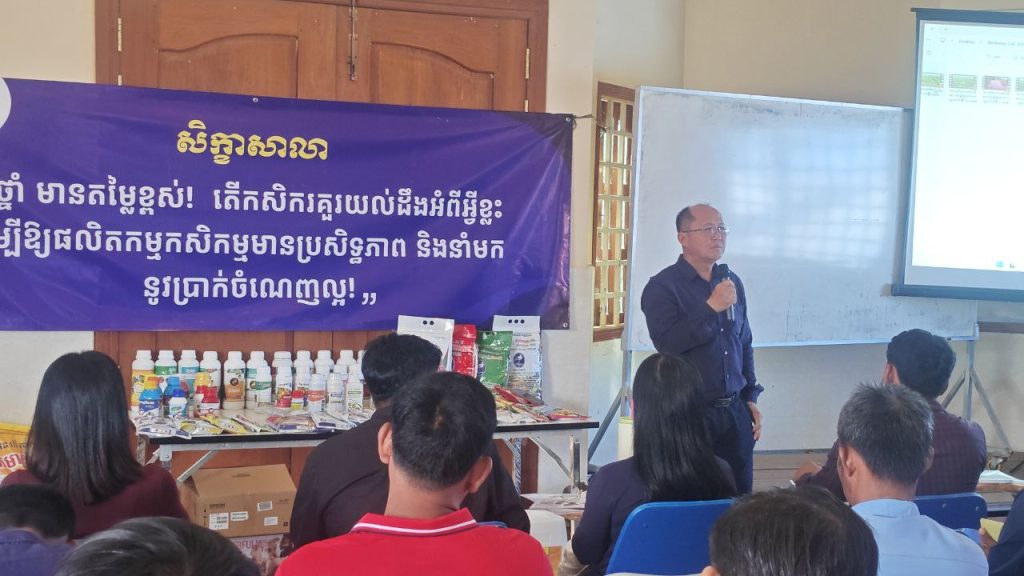
In an effort to support cashew farmers amid rising climate challenges, the Cashew Nut Association of Cambodia (CAC) has partnered with leading agricultural input companies to provide specialized training aimed at building resilience and promoting sustainable farming practices.
Under this collaboration, companies such as Angkor Green, Rohat Agro Tech, Rhino Master, Huy Yun Agriculture, UT Crop Protection, Agro Pharmacy, and VSR Agriscience have deployed their own agricultural science experts to deliver hands-on training to farmers across Cambodia.
The initiative in 2025 includes 40 planned training workshops hosted by CAC’s ten provincial branches, targeting over 5,000 farming households. To date, 23 workshops have already been conducted with 2,105 farmers in attendance. These sessions have been held in key cashew-producing provinces including Kampong Thom, Kampong Cham, Tboung Khmum, Kratie, Stung Treng, Ratanakiri, Preah Vihear, and Siem Reap. Notably, one workshop in Kampong Thom received financial support from HEKS/EPER Cambodia, an international NGO.
The core focus of the training is on reducing production costs and promoting climate-resilient agricultural practices. Farmers are being trained to minimize chemical use through integrated pest management, and instead are encouraged to use homemade alternatives like Highly Effective Micro-Organisms (HEM) and Indigenous Microorganism Bacillus Subtilis (IMOBs). These biological inputs help boost productivity while protecting the environment.
Climate-Smart Agriculture (CSA) principles are at the heart of the initiative. CSA is a sustainable approach to farming that aims to increase productivity, enhance resilience to climate change, and reduce greenhouse gas emissions. It promotes practices such as water-efficient irrigation, use of climate-resilient crop varieties, agroforestry, and digital tools for farm monitoring.
CAC is also preparing to introduce biochar—produced from rice husks and cashew shells—as part of a carbon-based fertilizer program in partnership with Modiri Climate Partner Pte. However, implementation is on hold until the government officially launches the Cashew Industrial Park (CIP). Cambodia’s agriculture sector faces challenges from increasing emissions and fertilizer dependence, and the biochar project aims to address these through sustainable technologies and community engagement.
Additionally, the workshops highlight intercropping and agroforestry techniques as key CSA practices. By growing multiple crops together, farmers can reduce soil evaporation, improve water retention, and increase overall productivity. Intercropping enhances biodiversity, soil health, and food security—critical components in building climate-resilient farming systems.
Through this initiative, CAC and its partners aim to empower farmers with the knowledge and tools they need to adapt to changing climate conditions, reduce environmental impact, and secure the future of Cambodia’s cashew industry.